
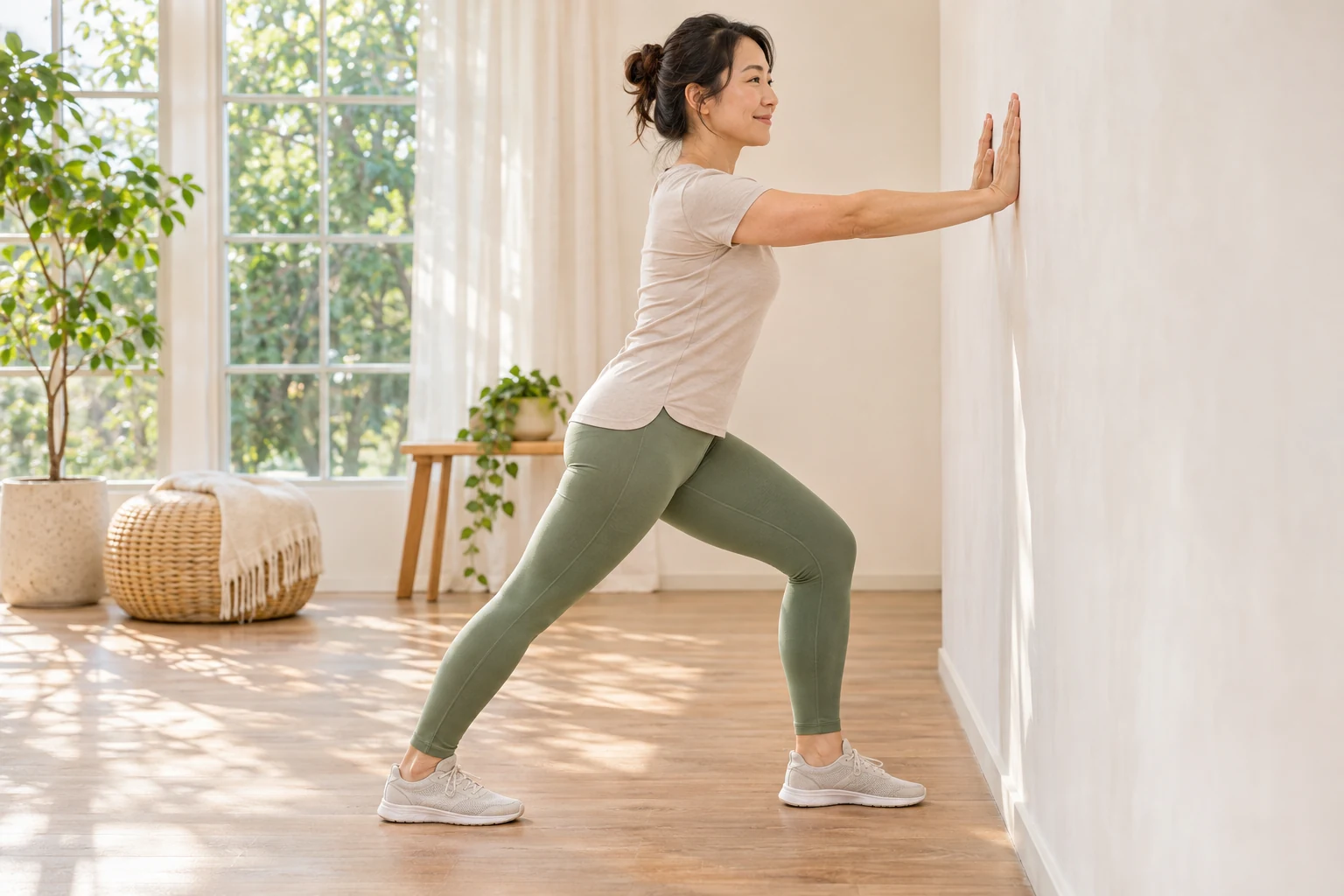
Your step-by-step routine
1. Level walking warm-up
5 minutes total: 4 minutes 30 seconds walking and 30 seconds to slow down beside the wall.
- Walk on a level surface with comfortable steps and a natural heel-to-toe action if that is comfortable for you.
- Gradually increase your pace a little without adding hills, bouncing or exaggerated toe push-offs.
- During the last 30 seconds, slow your pace and move to the wall.
Make it easier: Use a shorter stride and easier pace. Do not walk through calf or Achilles discomfort to complete the timer.
Watch for: Stop the routine if walking itself creates increasing symptoms. Stretching harder is not the next step.
2. Seated ankle preparation
1 minute: 10 seconds setup, 8 slow repetitions over 40 seconds, 10 seconds transition; one set.
- Sit on the chair with both feet flat and knees comfortably bent.
- Keeping your heels down, lift the fronts of your feet a small amount, then lower them.
- Next let your heels rise slightly with the balls of your feet down, then lower. Alternate the two actions for eight complete cycles.
Make it easier: Move one ankle at a time or use a smaller range.
Watch for: This is active ankle movement, not a sustained soleus stretch or a loaded calf-strengthening set.
3. Supported bent-knee calf hold
2 minutes: 2 holds of 20 seconds per side, with 10 seconds after each hold to release, reset or change legs.
- Place your palms against the wall. Step the right foot a short distance behind the left, with toes pointing comfortably forward.
- Keep the right heel on the floor and bend both knees slightly. Let your hips move a little forward and down without lifting that heel.
- Hold at mild lower-calf tension. Straighten a little to release, repeat, then place the left foot behind for the second side.
Make it easier: Shorten the stance, reduce the bend and use more hand support.
Watch for: Do not force the back knee inward or let the arch collapse to gain distance. A sharp pull around the Achilles is a reason to stop.
4. Seated heel-down soleus option
90 seconds: 15 seconds setup, 20 seconds each side, 15 seconds switching and 20 seconds transition.
- Sit near the front of the chair with your right foot slightly behind your knee and your whole foot resting on the floor.
- Keep the heel heavy and gently guide your knee forward by shifting your body a small amount toward that foot.
- Hold only if the position creates a comfortable stretch, then ease back and change feet.
Make it easier: Move the foot farther forward and reduce the shift. It is fine if the sensation is subtle.
Watch for: Do not push down on your thigh or add a dumbbell to make the stretch stronger. Keep the chair stable and do not perch on its edge.
5. Small knee-to-wall ankle rocks
90 seconds: 15 seconds setup, 5 repetitions per side over 60 seconds, 15 seconds release; one set.
- Face the wall with the right foot a short distance away and the left foot behind for support. Rest your hands on the wall.
- Bend the right knee toward the wall while keeping the right heel planted and the knee tracking in line with your toes.
- Move back slowly and repeat five times, then switch feet. Your knee does not need to touch the wall.
Make it easier: Move the front foot closer to the wall and use a smaller forward motion.
Watch for: This is active, partly weight-bearing ankle mobility, not a passive hold. Stop for a pinch at the front of the ankle instead of trying to push through it.
6. Easy stepping finish
1 minute: 40 seconds of easy walking or supported stepping, followed by 20 seconds standing comfortably.
- Bring your feet back under your hips and take relaxed steps on the level floor.
- Keep the step length ordinary instead of testing how far your ankle can travel.
- Finish near the chair or wall, with both feet on the floor and your breathing easy.
Make it easier: Use the wall for support or finish seated if you need to.
Watch for: Do not add repeated hopping, heel drops from a step or balance challenges as a test of whether the stretching worked.
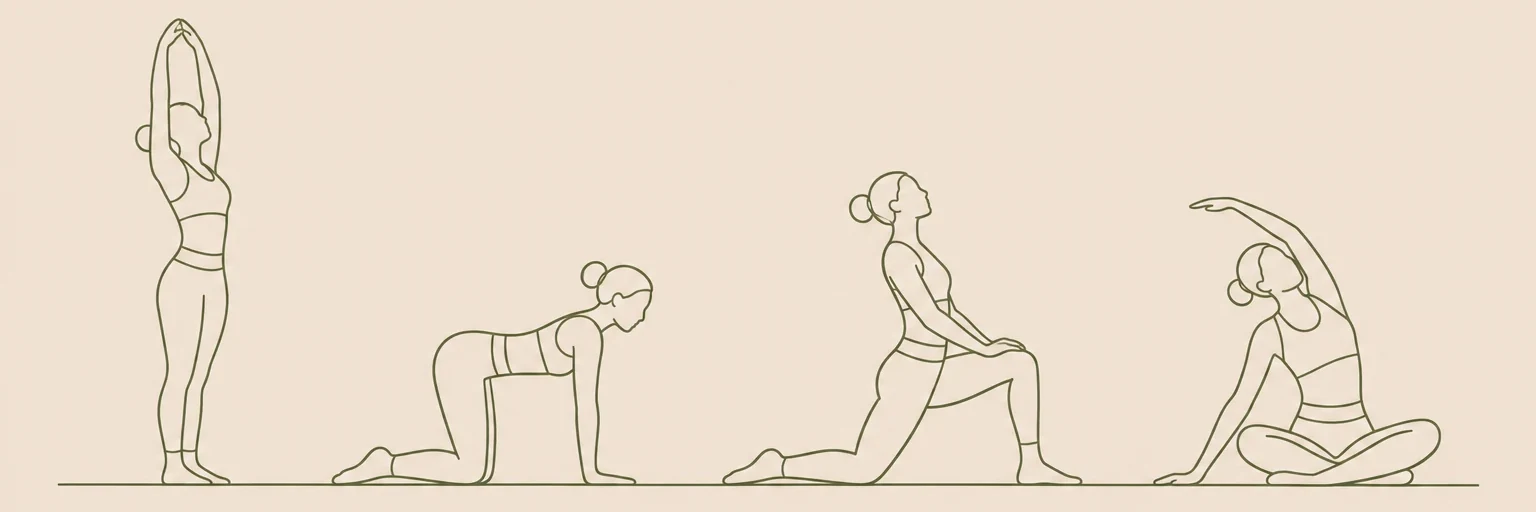
Illustrations are for orientation, not a depth or flexibility target.
Why bend the knee when stretching the soleus?
The soleus is one of the calf muscles and does not cross the knee. The larger gastrocnemius crosses both the knee and ankle; bending the knee reduces its contribution to the stretched position and changes the emphasis toward the soleus. It does not isolate the soleus completely.
Both versions involve ankle movement, so the heel position still matters. If your heel lifts as the knee bends, shorten the stance or decrease the motion. You do not need a deep squat, a long lunge or a large forward knee distance to use this routine.
Where should you feel a bent-knee calf stretch?
You may notice a broad pull lower in the calf than during a straight-knee stretch, but the sensation varies. The exact location does not diagnose which tissue is limiting your movement. Avoid chasing a stronger feeling near the heel or Achilles tendon.
Pressure at the front of the ankle is also different from a calf stretch. Moving the knee farther forward is not useful if it produces a pinch. Reduce the range, choose the seated option or leave that movement out rather than repeatedly testing the same uncomfortable endpoint.
Is a bent-knee calf raise a soleus stretch?
No. A calf raise asks the calf muscles to produce force as you lift the heel. A sustained heel-down position is a different task. Even though both can use a bent knee, they should not be treated as interchangeable exercises.
This routine deliberately avoids weighted seated calf raises and heel drops off a step. Those movements introduce loading and balance demands that need their own programming. The ankle rocks here are active mobility: you control a small movement through a comfortable range without adding weight.
How often can you repeat this lower-leg routine?
Start with one round on two or three days per week. If you are already warm from a walk, the remaining seven minutes can stand alone. Keep the same hold times initially and judge the session by whether it remains comfortable, not by whether your knee travels farther each day.
Before running or jumping, use your normal gradual activity-specific warm-up as well; a passive hold is not a replacement. For a separate standing option higher up the leg, see standing stretches for hip flexors.
When should you stop rather than stretch more?
Stop for sharp pain, increasing discomfort, numbness, tingling or a sudden change in how the leg feels. New one-sided calf swelling, redness, warmth or unexplained pain needs prompt medical assessment rather than a stretching session. Seek emergency help if this occurs with chest pain or breathlessness.
If you have an existing Achilles problem, recent ankle surgery or movement restrictions, ask your clinician whether these positions suit you. For unrelated upper-body flexibility, choose stretches for lats or browse the stretching hub instead of extending the calf session indefinitely.
Frequently asked questions
Should my heel stay on the floor?
Yes, for the standing bent-knee hold and knee-to-wall rocks. If the heel rises, move the feet closer together or reduce the knee bend. Pressing harder with your hands is not a useful substitute for choosing a smaller range.
Can I do soleus stretches seated?
Yes. The seated heel-down option reduces the standing balance demand. Keep the foot supported and guide the knee forward gently without placing a weight on your thigh. You may feel less tension than in standing, which is not a reason to force it.
Do these stretches prevent running injuries?
This routine makes no injury-prevention guarantee. Running involves training load, strength, recovery and many individual factors. Use stretching as an optional flexibility practice, not as permission to ignore symptoms or make sudden changes to your running.
Keep exploring stretches
Find more in our stretches guides, or make the timing your own with the routine builder.
Sources & context
These references inform general movement and safety guidance. The sequence and timings are editorial suggestions, not an individually prescribed program.