
Your step-by-step routine
1. Side steps and marching
2 minutes: alternate 30 seconds of marching in place with 30 seconds of side steps, twice.
- March in place at an easy pace, letting your arms swing naturally.
- Switch to stepping sideways: step your right foot out, bring the left foot to meet it, then reverse. Keep the steps small at first and widen them a little as you warm up.
Make it easier: Hold the back of a chair and march or tap each foot out to the side.
Watch for: This is about getting warm, not stretching yet. Keep the pace comfortable enough to talk.
2. Side-to-side leg swings
1 minute 30 seconds: 10 easy swings per leg over 40 seconds each, with 10 seconds to turn around.
- Stand facing a chair back or counter and rest both hands on it. Shift your weight onto your left leg.
- Swing your right leg gently across in front of your left, then out to the right side, like a slow pendulum. Let the swing grow only as far as feels smooth, then switch legs.
Make it easier: Make the swing small or simply slide the foot out and in along the floor.
Watch for: Keep your trunk upright and your hips facing the chair. The leg moves; your body stays still.
3. Standing side lunge stretch
2 minutes: 10 seconds setup, then 2 holds of 20 seconds each side with 5 seconds of rest after each hold, and 10 seconds to switch sides.
- Stand with your feet wide apart, about one and a half times shoulder width, toes pointing forward or turned out slightly. Rest your hands on your hips or a chair.
- Bend your right knee and shift your weight over your right foot, keeping your left leg straight and both heels down.
- Stop when you feel mild tension along the inside of your straight left leg. Breathe for 20 seconds, come back to center, then repeat before switching sides.
Make it easier: Use a narrower stance and bend the knee only a little, holding a chair for support.
Watch for: Keep the bent knee pointing in the same direction as your toes, not caving inward or drifting past the foot.
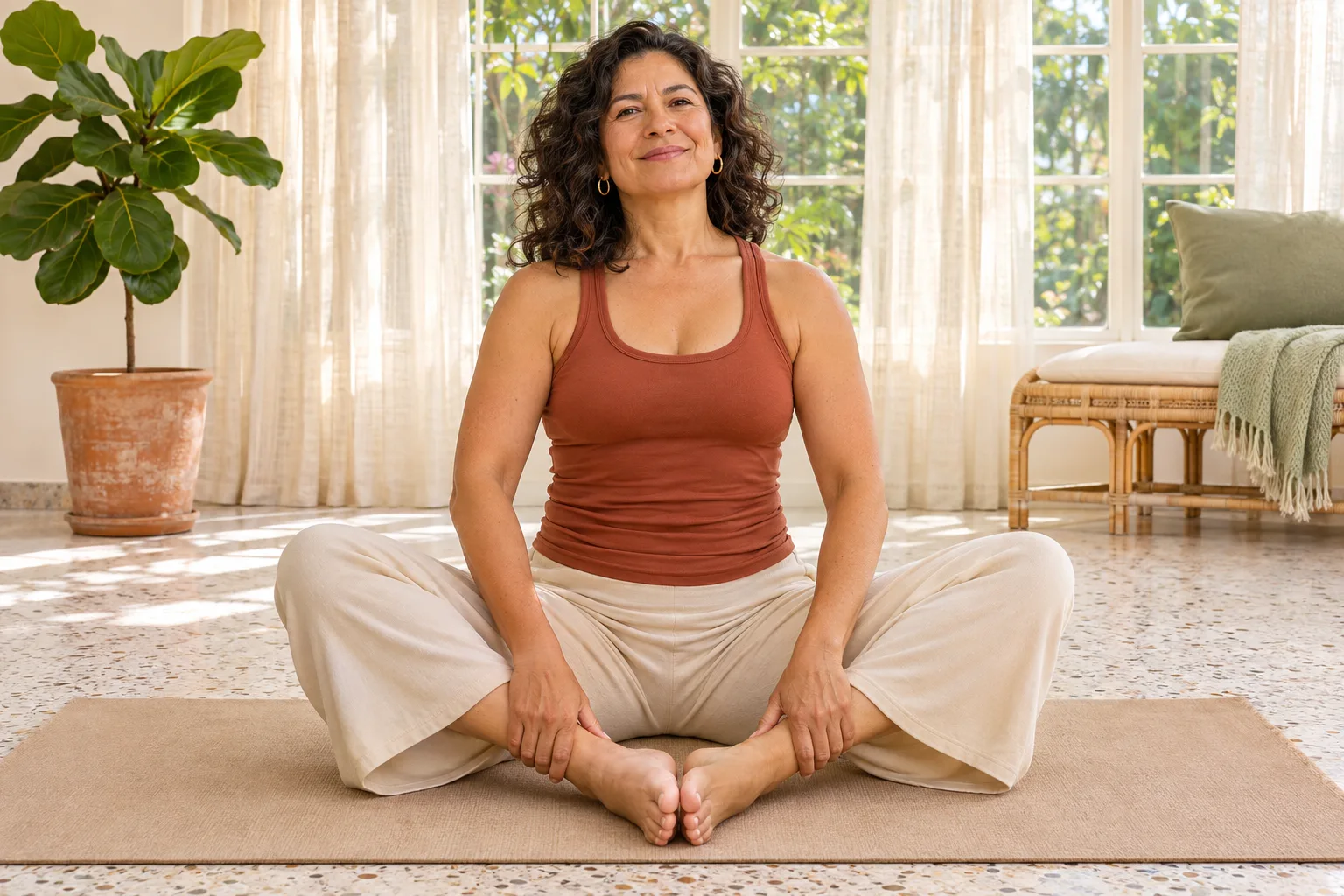
4. Seated butterfly stretch
2 minutes: 25 seconds to sit down and settle, then 3 holds of 25 seconds with 10 seconds of release between them.
- Sit tall on the mat with your knees bent. Press the soles of your feet together and draw your heels in to a comfortable distance.
- Hold your feet or ankles and let your knees lower toward the floor without pushing them.
- For a little more, lean forward from your hips with a long back. Hold, then sit up and let your knees rise between holds.
Make it easier: Move your feet farther from your body, sit on a folded towel and place a cushion under each knee.
Watch for: Avoid bouncing your knees or pressing them down with your elbows. Lean from the hips rather than rounding your back.
5. Lying knee drop-out
1 minute 30 seconds: 10 seconds to lie down, then 2 holds of 20 seconds each side (80 seconds).
- Lie on your back with both knees bent and feet flat on the floor.
- Let your right knee fall slowly out to the side, keeping your left knee pointing to the ceiling, until you feel mild tension in the right inner thigh.
- Rest there for 20 seconds, bring the knee back up, then repeat before switching sides.
Make it easier: Place a cushion under the knee that falls out so it has something to rest on.
Watch for: Keep your pelvis level on the floor. If it starts to roll, bring the knee back up a little.
6. Reclined butterfly rest
1 minute: one relaxed hold, breathing slowly.
- Still lying down, bring the soles of your feet together and let both knees open to the sides. Rest your arms by your sides and breathe slowly for one minute.
- To finish, press your knees together with your hands and roll onto your side before sitting up.
Make it easier: Support both knees on cushions or rest your feet farther from your body.
Watch for: This should feel restful. If it pulls more than lightly, add cushions until it does not.
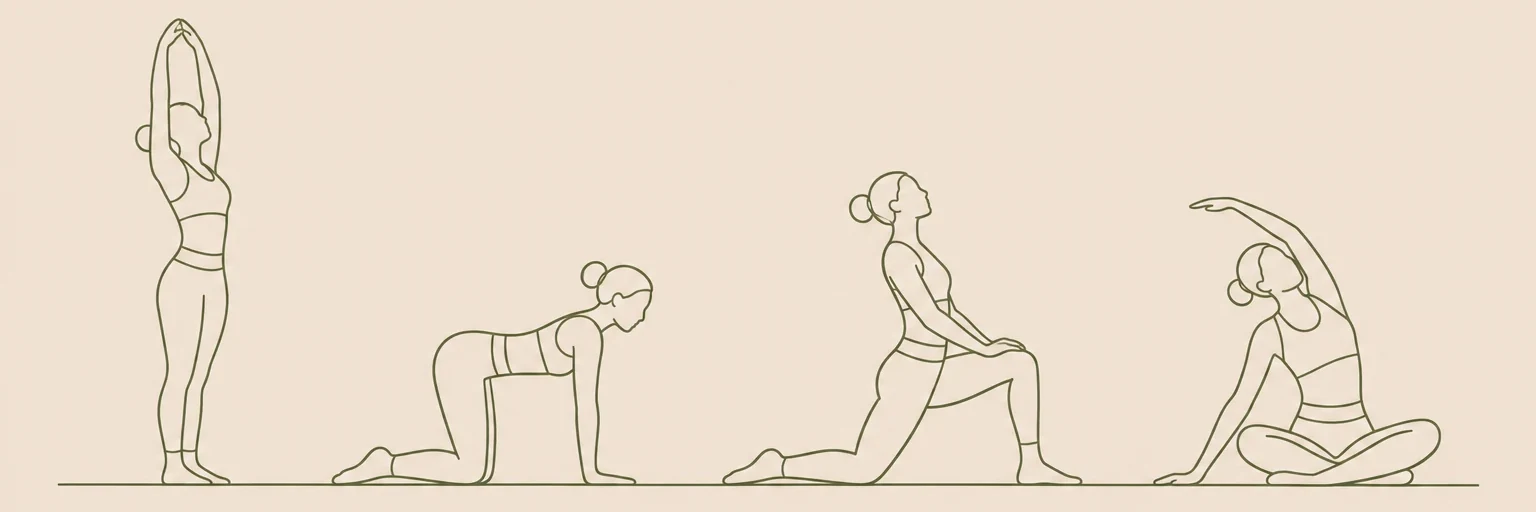
Illustrations are for orientation, not a depth or flexibility target.
What muscles do inner thigh stretches work?
The inner thigh is mostly the adductor group, muscles that run from the pelvis down the inside of the thigh. The AAOS describes their job simply: the adductors pull the legs together. A stretch therefore does the opposite, moving the legs apart or rotating the knees outward.
Because the adductors attach near the front of the pelvis, inner thigh holds often pair well with standing stretches for hip flexors. Together they cover the front and inside of the hip in one short session.
What is the best stretch for inner thighs?
The butterfly is the one most people know, and it appears in both the NHS after-exercise stretches and the American Council on Exercise exercise library. It suits anyone who is comfortable getting down to the floor.
The standing side lunge stretch is a good choice if sitting on the floor feels awkward, or as a quick option after a walk. The lying knee drop-out lets you work one side at a time, which helps if one leg feels tighter. There is no single best version; choose the one you can breathe and relax in.
How long should you hold an inner thigh stretch?
The NHS suggests holding its inner thigh stretch for 15 to 20 seconds. ACE suggests 15 to 30 seconds at a point of mild tension, repeated two to four times, without bouncing. This routine uses 20-second holds so it stays close to 10 minutes.
ACE also recommends warming up for five to 10 minutes before stretching. The warm-up here is a minimum; take longer on a cold day or if your hips feel stiff.
When should you avoid stretching your inner thighs?
Normal stretching feels like mild, even tension that eases as you breathe. Sudden sharp pain on the inside of the thigh is different. The AAOS notes that thigh muscle strains often come with a popping or snapping sensation, sudden pain, tenderness and sometimes bruising or swelling. Those signs need a clinician's assessment rather than more stretching.
If you have had a recent hip or groin injury, hip surgery or been given movement restrictions, ask the clinician looking after you which positions are suitable before starting.
How often should you stretch your inner thighs?
Start with one round on two or three days a week. On other days, beginner hip mobility exercises take the hips through active movement, and runners can add hip mobility exercises for runners before easy runs.
For more focused routines, browse the stretching hub, or let the routine builder time a short hips session for you.
Frequently asked questions
Why are my inner thighs so tight?
Stiffness through the inner thigh is common, especially if you sit for long periods or rarely move your legs out to the side. A stretch cannot tell you the cause. If tightness comes with pain, swelling or follows an injury, check with a clinician.
Why won't my knees go down in the butterfly stretch?
Hip shape and range vary a lot between people, and many never get their knees close to the floor. Slide your feet farther away, sit on a folded towel and rest your knees on cushions. The stretch still works at that height.
Can I stretch my inner thighs sitting in a chair?
Yes. Sit near the front of a sturdy chair with your feet wide and toes turned out slightly, then lean forward from the hips with your hands on your thighs until you feel mild tension along the inner thighs.
Keep exploring stretches
Find more in our stretches guides, or make the timing your own with the routine builder.
Sources & context
These references inform general movement and safety guidance. The sequence and timings are editorial suggestions, not an individually prescribed program.