
Your step-by-step routine
1. March in place with relaxed arm swings
4 minutes: 3 minutes 30 seconds of easy marching, then 30 seconds walking to the wall.
- March in place or walk slowly around the room, letting your arms swing naturally beside you.
- Gradually lift your knees a little higher and let the arm swing grow slightly as you warm up.
- Keep your shoulders loose and your breathing easy. Finish by walking to the wall you will use next.
Make it easier: Walk instead of marching, or sit on a sturdy chair and march your feet while your arms rest on your thighs.
Watch for: Do not fling your arms backward to force a stretch. The goal is gentle warmth, not range.
2. Elbow bend and palm turn
1 minute: 10 seconds setup, 8 slow repetitions over 40 seconds, 10 seconds rest; both arms together.
- Stand tall with your arms by your sides and palms facing forward.
- Slowly bend both elbows to bring your hands toward your shoulders, then lower them until the arms are nearly straight.
- At the bottom of each repetition, turn your palms to face behind you, then turn them forward again before the next bend.
Make it easier: Do one arm at a time, or make the bend smaller and keep your elbows close to your ribs.
Watch for: This is unweighted preparation. Do not hold dumbbells or snap the elbow straight at the bottom.
3. Single-arm wall biceps stretch
2 minutes 30 seconds: 2 holds of 20 seconds each side, 10 seconds to release or reset after each hold, 10 seconds to switch sides.
- Stand with your right side next to a wall, about an arm's length away. Reach your right arm back and place the palm flat on the wall at or just below shoulder height, fingers pointing behind you.
- Keep the elbow straight but soft. Slowly turn your feet and chest a small amount to the left, away from the wall, until you notice mild tension in the front of the upper arm or shoulder.
- Breathe normally for 20 seconds, then turn back toward the wall to release. Repeat once on the right, then switch to the left arm.
Make it easier: Place your hand lower on the wall and turn less. You can also keep the elbow slightly bent.
Watch for: Stop if you feel pinching at the front of the shoulder or tingling down the arm. Do not lean your body weight into the wall.
4. Countertop two-arm stretch
1 minute 30 seconds: 15 seconds setup, 2 holds of 20 seconds with 15 seconds of rest between, 20 seconds to move to the mat.
- Stand with your back to a sturdy countertop or table and rest both palms on the edge behind you, fingers pointing back or to the sides, shoulder-width apart.
- Keep your elbows straight but soft and your chest relaxed. Take a small step forward or bend your knees slightly to increase the angle at the shoulders.
- Stop at gentle tension along the front of both arms. Hold, then step back toward the counter to release.
Make it easier: Stay closer to the counter, or use one arm at a time while the other hand rests on your hip.
Watch for: Do not drop into a deep squat while your hands stay fixed; that pulls the shoulders forward. Skip this hold if the furniture moves.
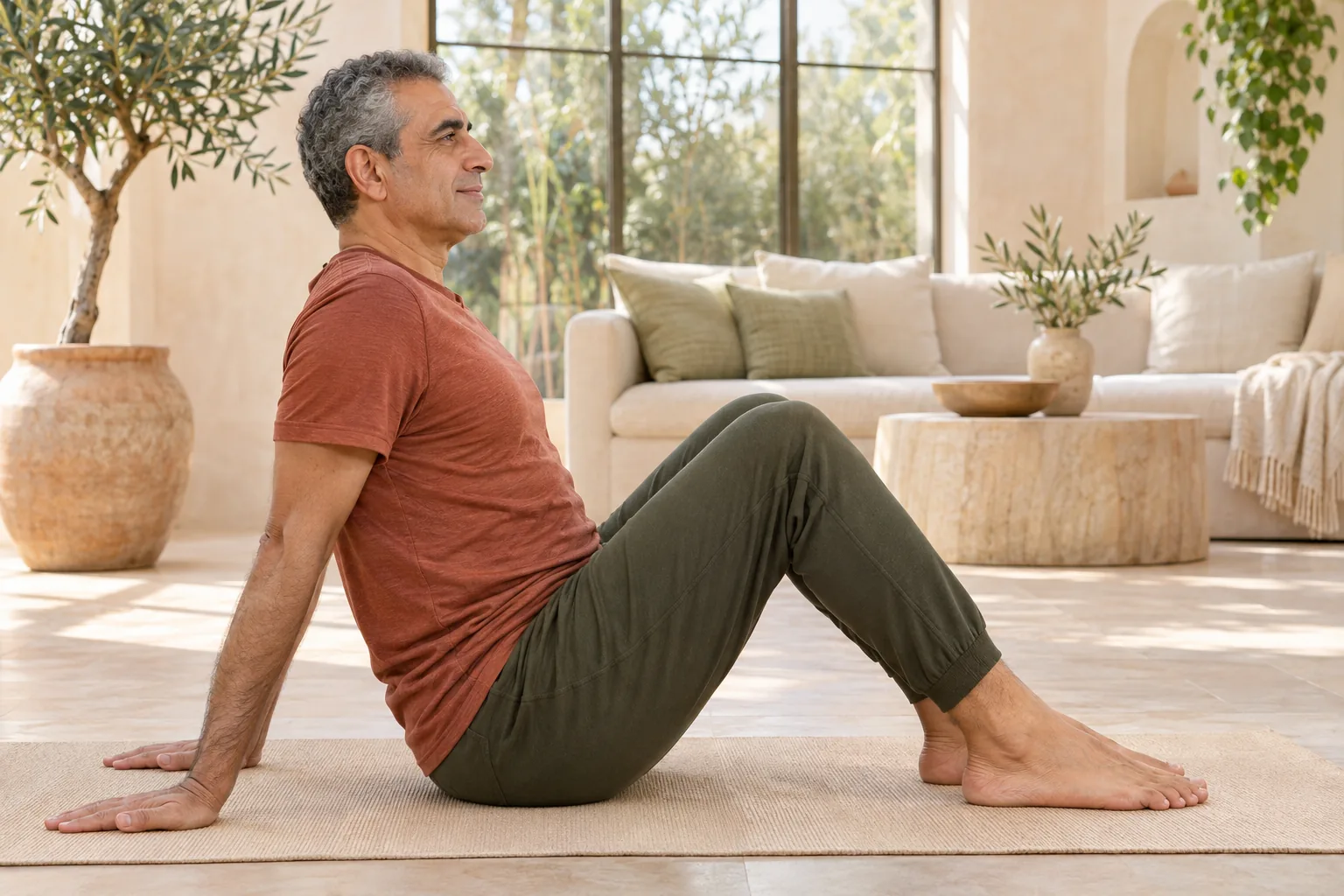
5. Seated bent-knee biceps stretch
2 minutes: 20 seconds to sit and set up, 3 holds of 20 seconds with 10 seconds of rest between, 20 seconds to sit back up.
- Sit on your mat with knees bent and feet flat. Place both palms on the mat behind you with fingers pointing away from your body.
- Keep your back long, neither arching nor slumping, and your head in line with your spine.
- Slowly slide your hips a few inches toward your feet without moving your hands, until you feel tension through the front of the arms and shoulders. Hold, then slide back to release.
Make it easier: Move your hands closer to your hips, or turn your fingers out to the sides if pointing them backward strains your wrists.
Watch for: Never bounce. Stop sliding at the first point of clear tension, and skip this hold if putting weight on your hands is uncomfortable.
6. Relaxed arm reset
1 minute: 20 seconds to stand carefully, then 40 seconds of easy shoulder rolls and walking.
- Roll to your side and come up to standing in your usual way, using a chair for support if you need it.
- Roll your shoulders slowly forward and back a few times, then walk for the remaining seconds.
Make it easier: Stay seated and roll your shoulders there.
Watch for: Pause if you feel lightheaded when standing up from the floor.
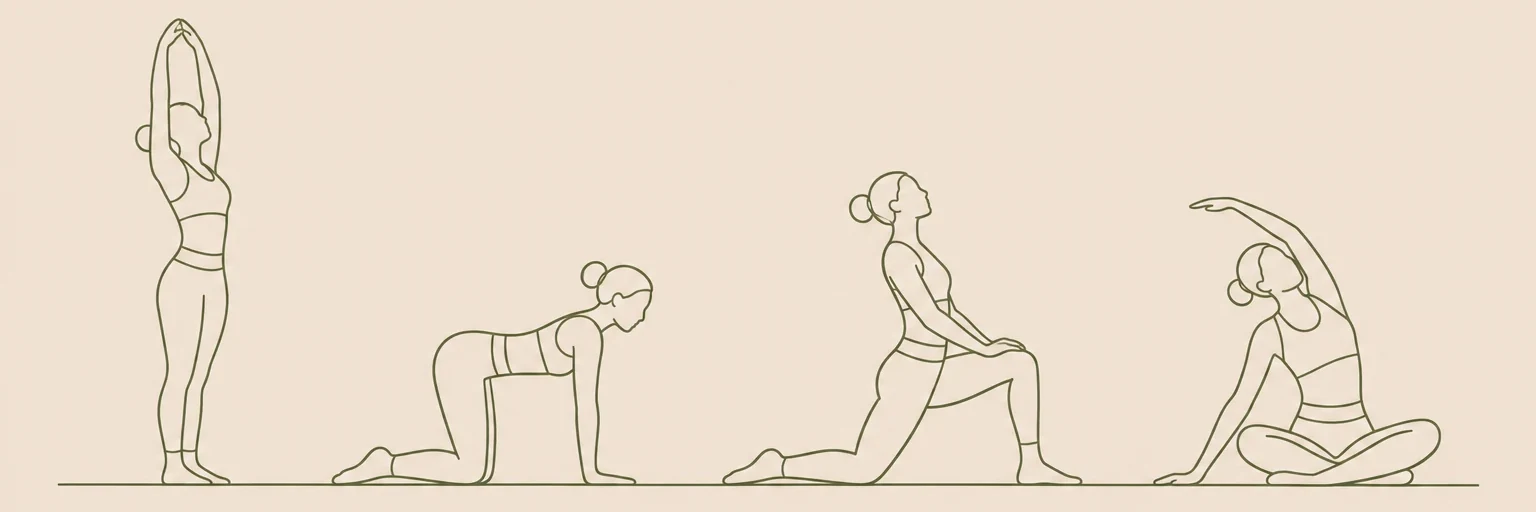
Illustrations are for orientation, not a depth or flexibility target.
How do you stretch your biceps?
The biceps runs along the front of the upper arm. It crosses both the elbow and the shoulder, and it helps bend the elbow and turn the palm up. A biceps stretch reverses those actions: the elbow straightens, the palm faces down or back, and the arm moves slightly behind the body.
You will often notice the stretch near the front of the shoulder as much as in the middle of the arm. That is normal, because the chest and front shoulder also lengthen in these positions. If you want a stretch that focuses on the chest instead, try the doorway holds in stretches for chest.
Wall, countertop or floor: which biceps stretch should you choose?
The wall stretch is the easiest to adjust. You work one arm at a time, your feet carry all your weight, and you can change the hand height and body turn in small steps.
The countertop stretch works both arms at once and suits people who would rather not get down on the floor. The seated floor stretch, based on the American Council on Exercise's seated bent-knee biceps stretch, puts some of your weight through your hands and wrists. Choose it only if that feels comfortable. One or two holds you enjoy are enough.
How long should you hold a biceps stretch?
ACE suggests holding a static stretch for 15 to 30 seconds at a point of mild tension, then relaxing and repeating it two to four times. This routine uses 20-second holds so you can complete two or three per position without rushing. Breathe out slowly as you settle into each hold, and never bounce.
ACE also recommends warming up for five to 10 minutes before stretching, starting with something easy such as walking with gentle arm swings. The four-minute march at the start of this routine is a minimum; add a few minutes if your arms still feel cool.
Can you stretch sore biceps after a workout?
Gentle holds after curls, rows or pull-ups are fine if they feel comfortable. Keep the tension mild, because tired muscles can make it easy to push further than usual. A Cochrane review found that stretching before or after exercise made little difference to next-day muscle soreness, so there is no need to hold longer or press harder after a hard session.
Sudden, sharp pain at the elbow or the front of the shoulder is different from ordinary soreness. The NHS notes that sudden, severe pain during activity, sometimes with a popping or snapping sound, can mean a torn tendon. A new bulge in the upper arm, bruising or weakness when bending the elbow or turning the palm up also needs a clinician's assessment, not a stretch. The AAOS describes biceps tendinitis as typically causing pain at the front of the shoulder; if a stretch keeps provoking that pain, stop and get individual advice.
How often should you stretch your biceps?
Begin with one round on two or three days a week, the same frequency we suggest for our other stretching routines. Pair it with shoulder mobility exercises on a different day for active movement through the same joint.
For an overhead option that works the side of the back, see stretches for lats. The stretching hub lists every focused routine, and the routine builder can time a short session around the minutes you have.
Frequently asked questions
Why do I feel a biceps stretch in my shoulder?
The biceps attaches above the shoulder joint, so moving the arm behind you lengthens it near the shoulder as well as the elbow. Mild tension at the front of the shoulder is common. Pinching, sharp pain or tingling is a cue to lower your hand or stop.
Should my palm face up or down in a biceps stretch?
A palm facing down or back usually increases the stretch, because the biceps helps turn the palm up. If that wrist position is uncomfortable, let your fingers point to the side and keep the tension lighter.
Is the biceps femoris the same muscle?
No. The biceps femoris is one of the hamstrings at the back of the thigh. This routine is for the biceps in the upper arm. Hamstring holds need a different setup, such as a seated or supported leg stretch.
Keep exploring stretches
Find more in our stretches guides, or make the timing your own with the routine builder.
Sources & context
These references inform general movement and safety guidance. The sequence and timings are editorial suggestions, not an individually prescribed program.