

Your step-by-step routine
How is the ten-minute sequence organised?
Complete the two-minute warmup, then give each of the six stations one minute. The spare time after the listed repetitions is deliberate rest. Allow twenty seconds between movements to reset your seat or stand up for the final wall movement. Finish with twenty seconds of relaxed sitting or standing. Instruction-reading and setting up the space happen before the timer.
This is one round, not six continuous minutes of twisting. If you need more time to stand or find a comfortable position, extend the session. The first five stations can all remain seated; you can use the suggested seated alternative for the final station rather than rush a transfer.
1. Seated rib-cage breathing
One set of 5 comfortable breaths, about 6 seconds each, followed by a quiet pause within the minute.
- Sit with both feet supported and your hands resting lightly on the sides of your lower ribs.
- Breathe in gently and notice the rib cage moving under your hands without lifting your shoulders.
- Let the air leave without squeezing or holding your breath. Keep the breath ordinary in size; no maximum inhalation is needed.
Make it easier: Rest your hands in your lap and sit against the chair back.
Watch for: This is a settling exercise, not a breathing-capacity test. Return to your normal breathing and stop if you feel lightheaded.
2. Seated upper-back rounding and return
One set of 6 cycles at roughly 6 seconds each. Rest for the remaining station time.
- Place your hands loosely on your thighs with feet flat and your pelvis resting evenly on the chair.
- Exhale normally as you let the upper back round a little and the breastbone soften backward.
- Return to your ordinary upright sitting position. Keep the movement gentle rather than collapsing deeply or throwing your head back.
Make it easier: Use a very small rounding movement with your hands supporting you on your thighs.
Watch for: Do not pull your head forward or push into a strong spinal stretch. Skip this if forward bending is restricted for you.
3. Small seated breastbone lift
One set of 6 repetitions, about 5 seconds each, then rest until the minute ends.
- Stay seated upright, hands resting at the sides of your ribs and chin approximately level.
- Let the breastbone lift slightly as your upper back lengthens. Think of a small opening across the front of the rib cage.
- Return to neutral. Keep the lower ribs from flaring forward and avoid tipping your pelvis into a large lower-back arch.
Make it easier: Simply move from a mildly rounded position back to upright without adding a backward bend.
Watch for: There is no need to lean over the chair back. A bigger lower-back arch does not mean more upper-back movement.
4. Seated rotation with arms crossed
One set of 4 turns each way, alternating at about 5 seconds per turn; pause for the rest of the minute.
- Cross your arms loosely across your chest with both feet flat and knees facing ahead.
- Turn your breastbone a short distance to the right while allowing your head to follow comfortably.
- Return to the middle before turning left. Keep your seat bones down and let your arms travel with your trunk.
Make it easier: Keep your hands on your thighs and make the turn smaller.
Watch for: Do not hook your arm around the chair to lever yourself farther. Keep the knees still without squeezing them rigidly together.
5. Seated diagonal reach
One set of 4 reaches per side, alternating at about 5 seconds per reach. Rest within the station.
- Rest your left hand on your left thigh. Reach your right hand forward and slightly across your body at lower-chest height.
- Allow a small turn through your rib cage without lifting your right hip or bending far sideways.
- Bring the hand back, sit evenly and switch sides. Your eyes can follow the hand if that is comfortable.
Make it easier: Keep the elbow bent so the hand stays closer to your body.
Watch for: This is an active reach, not a pull into a held stretch. Keep the arm below shoulder height if higher reaching feels awkward.
6. Supported standing upper-back rock
One set of 6 small rocks, about 6 seconds each, with the remainder of the minute for rest.
- Stand facing a wall with both palms planted at chest height and feet a comfortable step away.
- Soften your knees and move your hips back slightly as your trunk inclines, letting your chest settle a little between your arms.
- Return toward upright without bending the elbows deeply. Keep the motion small and the neck relaxed.
Make it easier: Stay closer to the wall and use only a tiny backward shift, or repeat the seated breastbone lift instead.
Watch for: Do not hang heavily from your shoulders or force your chest downward. Stop if the position feels uncomfortable in your wrists or shoulders.
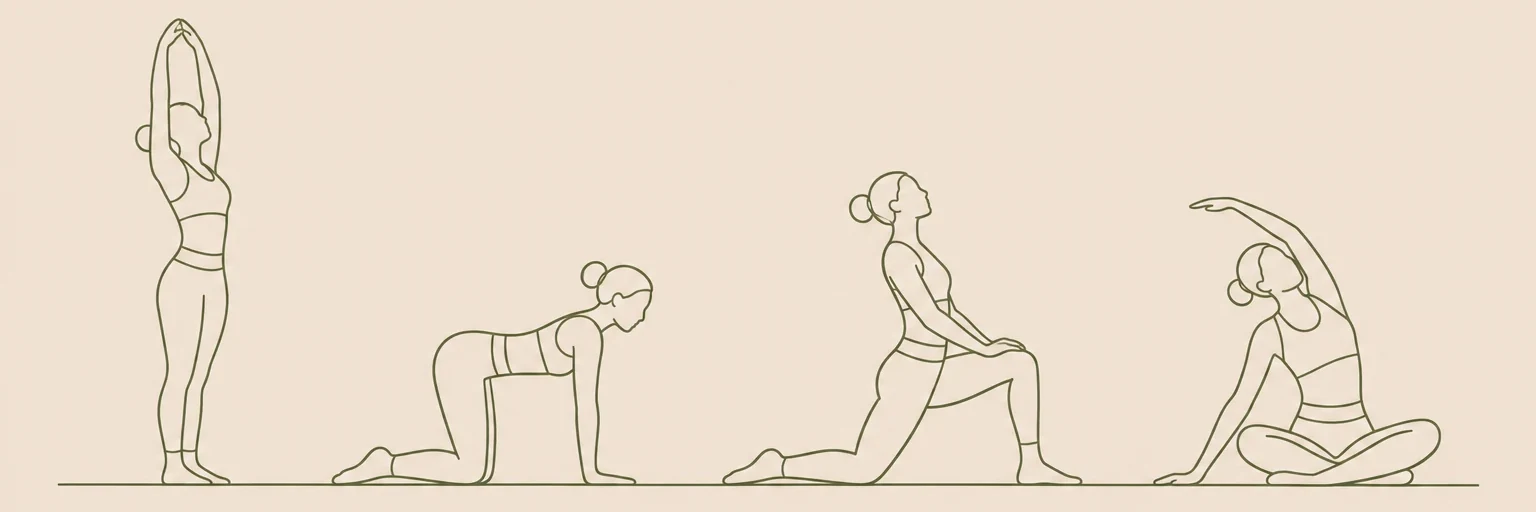
Illustrations are for orientation, not a depth or flexibility target.
Where should the movement come from?
The thoracic region is the middle portion of your spine, where the ribs attach. You cannot completely isolate it from the shoulders, neck and lower back, but you can keep those areas from exaggerating the motion. In a rotation, notice your breastbone turning rather than leading with your chin. In an extension, watch for the lower ribs tipping forward.
These cues are ways to make the exercise more specific, not instructions to brace everything rigidly. Let your breathing continue and use a range you can reverse smoothly. A barely visible turn with control is a reasonable starting point; the aim is not to point your elbow behind you.
Is this stretching, strengthening or posture training?
Most movements here are active mobility: your muscles move you through a chosen range, then bring you back. The wall station adds some arm support and light body-weight loading. None is intended as a long passive stretch. A gentle sense of movement around the ribs is enough; do not ask another person to push you farther.
The routine does not promise to change your resting posture or resolve back symptoms. Sitting has many comfortable variations, and movement breaks can include ordinary walking as well as exercises. The mobility exercise hub offers different areas to explore when you want variety.
Who should choose a different option?
Do not use a general routine to work through unexplained back or chest discomfort. Stop for sharp or increasing pain, new tingling, numbness, dizziness or breathlessness beyond what you expect from gentle movement. Chest pressure, severe breathlessness or feeling faint calls for urgent medical help, not another exercise.
If you have osteoporosis, a recent fracture, spinal surgery or restrictions on bending or twisting, get individual clearance and exercise selection first. Begin with two or three sessions weekly if these movements are appropriate for you, and assess the later response before repeating. For arm-focused practice, see shoulder mobility exercises; for a session without trunk rotation, explore ankle mobility exercises.
Frequently asked questions
Do I need a foam roller?
No. This sequence uses a chair and wall. A roller is not required for upper-back movement, and leaning backward over one can add pressure or range that is unnecessary for a beginner.
Should I try to make my back click?
No. A sound is not a measure of a useful repetition. Do not pull or bounce to create one. Stop if a sound comes with discomfort, catching or a new symptom.
Can I do this after desk work?
You can use it as a movement break if the positions suit you. Start with the warmup rather than immediately twisting as far as possible. A short walk is also a reasonable choice when you do not want a full routine.
Keep exploring mobility
Find more in our mobility guides, or make the timing your own with the routine builder.
Sources & context
These references inform general movement and safety guidance. The sequence and timings are editorial suggestions, not an individually prescribed program.